





Table of Contents
Voter identification laws are rules that require voters to show an official ID when registering, receiving a ballot, or voting in person. As of May 2022, 36 U.S. states require or request some form of ID at the polling place, with important differences in the type of ID accepted and how strictly the rules are enforced.
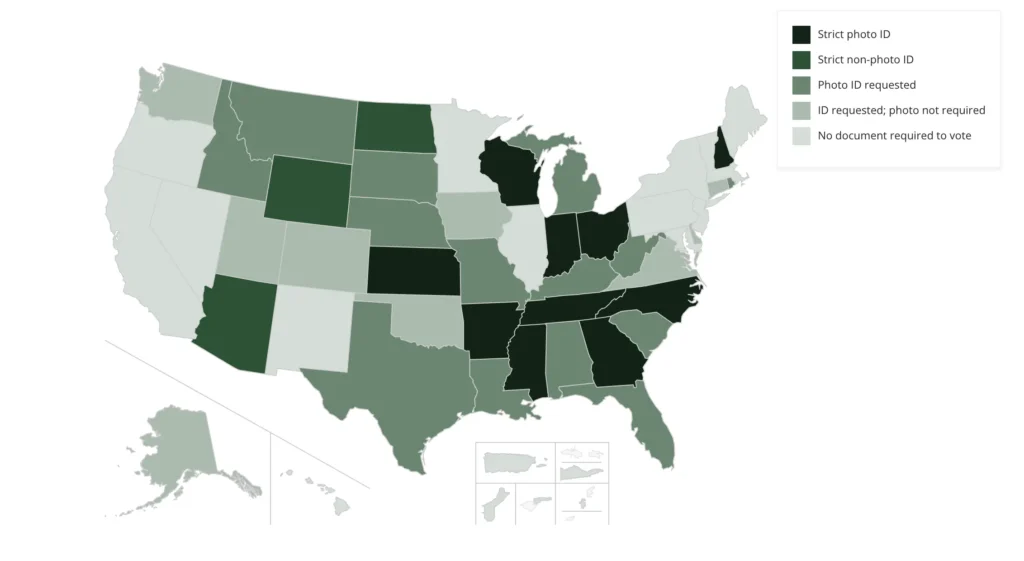
Source: NCSL org
Voter identification laws in the United States answer a simple but important question:
What identification do you need to vote on Election Day?
The answer depends on where you live. Some states require a government-issued photo ID, others accept non-photo documents, and a few do not require ID at the polling place at all. As of 2025, most states require or request some form of identification to vote in person, though the rules vary widely.
That’s why understanding voter ID laws ahead of time matters – for voters, campaigns, and election organizers alike.
A short summary box:
- Most US states now require or request some form of ID to vote in person.
- States differ on whether they accept only photo IDs or also non-photo documents like utility bills or bank statements.
- First-time voters who registered by mail face additional federal ID rules under the Help America Vote Act (HAVA).
- Some states offer exceptions or backup options, such as signing an affidavit or casting a provisional ballot.
- Voter ID laws change frequently, so voters should always verify the latest requirements with their state election office before an election.
You can adapt each bullet to your tone, but keep them short, factual, and scannable.
What are voter ID laws?
Voter identification laws require voters to prove their identity before they can register, receive a ballot, or vote, usually by showing a government‑issued document such as a driver’s license, passport, or state ID. These rules sit on top of federal minimums in laws like the Help America Vote Act and differ widely across states in both the type of ID accepted and the consequences if a voter lacks ID.
Voter ID laws are rules set by federal and state governments that require voters to verify their identity during the voting process. These requirements may apply:
- When referring to vote
- When receiving or casting a ballot
- At the polling place on election day
In most areas, legal identification must have enough information to confirm a voter’s identity and eligibility. However, what qualifies as acceptable identification differs from state to state.
Supporters of voter identification laws say these rules protect election integrity and prevent fraud. Critics argue they may discourage participation, particularly among voters who face barriers to obtaining ID.
Read Also: The Power of Voter Engagement: Key Strategies for Success
Voter identification laws at a glance
Here’s a quick overview before we dive deeper:
- How many states require an ID to vote?
More than 30 states require or request ID at the polls. - How many states have strict voter ID laws?
11 states enforce strict requirements with limited alternatives. - Do all states require ID on Election Day?
No. About 15 states do not require ID at the polling place. - Does Social Security count as voter ID?
No. A Social Security number alone is not accepted at polling locations. - Does REAL ID work for voting?
Yes, where state law allows it. REAL ID is accepted as a valid form of identification in states that permit photo ID.
Read Also: How to Make Your Voter Outreach Boost Every Kind of Voter Bloc
Key voter ID terms and definitions
Understanding a few core terms makes it easier to navigate voter ID laws by state and see how they affect your outreach.
- Voter identification laws: State rules that require or request ID when someone registers, checks in at a polling place, or casts a ballot.
- Voter ID laws: Practical rules that define what voter ID laws are in everyday terms – what ID a voter must show, when, and what happens without it.
- Photo ID: Identification with a photo, such as a driver’s license, state ID, US passport, or sometimes student or tribal cards.
- Non-photo ID: Documents like utility bills, bank statements, paychecks, or voter registration cards that confirm a voter’s identity or address.
- Strict voter ID law: If a voter lacks acceptable ID, they usually must cast a provisional ballot and complete extra steps for it to be accepted, cast, and counted.
- Non-strict voter ID law: Voters without ID often have another option, such as signing an affidavit or returning later with ID.
- Help America Vote Act (HAVA): Federal law that, among other reforms, created ID requirements for some first-time voters in federal elections.
In most areas, legal identification must have a name that matches the voter rolls and, in many cases, an address or photo, depending on state rules
Read Also: Making Voter Persuasion Calls That Count: Elements & Scripts to Get Started
History of Voter Identification Laws in the U.S.
Voter identification laws in the United States have evolved over time, reflecting changes in societal attitudes and legal interpretations.
📜 Early Developments
- 1950: South Carolina pioneered the first voter ID law, requiring voters to present a non-photo identification document at the polls.
- 1970s–1990s: Several states introduced similar laws, generally uncontroversial and aimed at streamlining the voting process.
📸 Shift to Photo ID Requirements
- 2004: Arizona became the first state to mandate a photo ID for voting, marking a significant shift in voter ID legislation.
- 2005: Indiana enacted a strict photo ID law, which was upheld by the U.S. Supreme Court in the 2008 case Crawford v. Marion County Election Board, setting a precedent for other states.
⚖️ Legal Challenges and Debates
Proponents argue that voter ID laws prevent fraud and enhance electoral integrity. Critics contend that these laws can suppress voter turnout, particularly among minorities, the elderly, and low-income populations.
The 2013 Supreme Court decision in Shelby County v. Holder invalidated key provisions of the Voting Rights Act, leading to a surge in state-level ID laws without federal oversight.
Types of voter identification laws
States first experimented with non-photo voter ID requirements in the mid‑20th century, but these rules remained relatively limited and low profile for decades.
The debate intensified in the 2000s, when Arizona and then Indiana adopted photo ID requirements, and the U.S. Supreme Court upheld Indiana’s law in Crawford v. Marion County Election Board, encouraging many other states to consider similar policies.
Today, voter ID laws differ mainly along two dimensions: whether they require a photo ID or accept non-photo documents, and whether they are strict (no fallback if a voter lacks ID) or non-strict (with alternatives such as affidavits or provisional ballots). Let’s explore:
1. Photo ID Vs. non-photo ID laws
A photo identification, as the name suggests, is an official identification document with the holder’s photo on it. Acceptable photo identification documents include:
- A valid driver’s license (some states require it to be issued in that state itself; Some states accept a driver’s license that expired not more than 60 days before. Please check your state laws before election day).
- State Election Identification Certificate
- Personal Identification Card issued by the state Department of Public Safety (DPS)
- United States Military Identification Card
- United States Citizenship Certificate
- A US passport
Some states also accept a Handgun driver’s license as a photo ID.
Acceptable non-photo IDs include:
- Utility bills
- Bank statements or credit union bills (dated within 90 days of the election date)
- State vehicle registration or insurance
- Property tax statements
- Voter registration card
- Recorder’s certificate
- Census card
- Tribal identification (e.g., Tribal enrollment card)
- Any mailing or identification labeled as “official election material”.
With that, we move on to the strictness of voter ID laws.
You May Also Like: How Democrats Abroad Drove 300% Increase in Overseas Voter Turnout with Phone Calls.
2. Strict Vs. Non-strict state voter identification laws
States with strict voter identification mandates do not make exceptions and require the voter to produce any one of the acceptable documents at the election booth. The required ID can be a photo ID or a non-photo ID, depending on the state.
Non-strict states are more lenient, and if a voter doesn’t possess any required ID, they may:
- Sign a sworn affidavit attesting to their identity.
- Sign a reasonable impediment declaration.
- Have one of the poll workers vouch for them.
First-time voters may have more requirements on top of the above voter identification laws. Let’s look at them before going into the state-wise voter identification laws.
Voter identification laws for first-time voters
The Help America Vote Act (HAVA), enacted in 2002, is a federal law that sets minimum identification requirements for certain first‑time voters who registered by mail and did not provide ID during registration. These voters must show a valid photo ID or an approved non‑photo document the first time they vote.
Acceptable documents under HAVA include:
- A current and valid photo identification document,
- A copy of a recent utility bill,
- Paycheck,
- Bank statement,
- Government check or other government-issued documents.
These federal rules apply on top of state laws, including in states that otherwise have non‑photo ID rules, non‑strict ID requirements, or no general in‑person ID requirement, so first‑time voters should always confirm what they need before Election Day.
Read Next: Political Canvassing Laws Every Campaigner Must Be Aware Of
State-wise voter identification laws
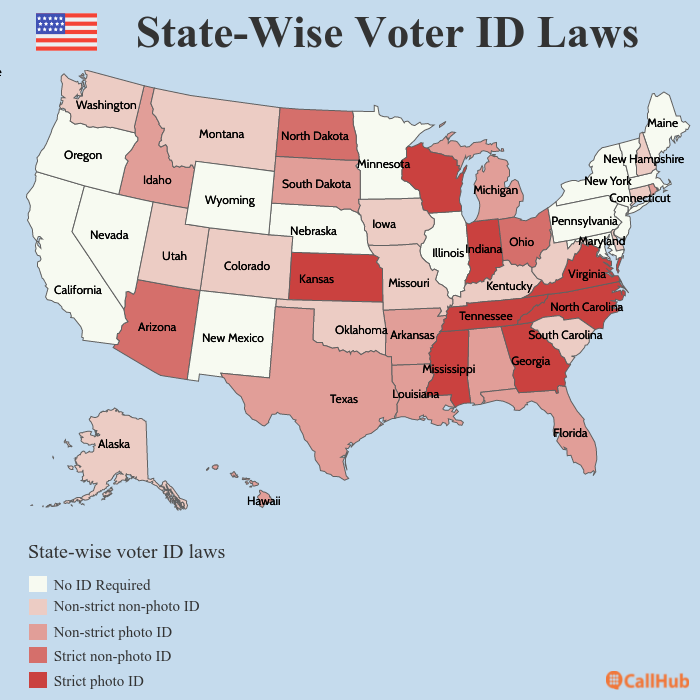
Photo ID laws have always invited controversy from the Democrats. When Indiana passed the first strict photo ID law in 2005, the Marion County (Indianapolis) Democratic Central Committee challenged it, citing obstacles against the 14th Amendment. However, the courts struck down that challenge, saying that the state had a reasonable interest in introducing such election laws.
It’s 17 years later, and more and more states have adopted some variation of the photo ID law. Missouri is the latest in line, but that law is still in progress and hasn’t yet passed while I write this article.
Here is a breakdown of how many and which state follows which of the voter identification laws:
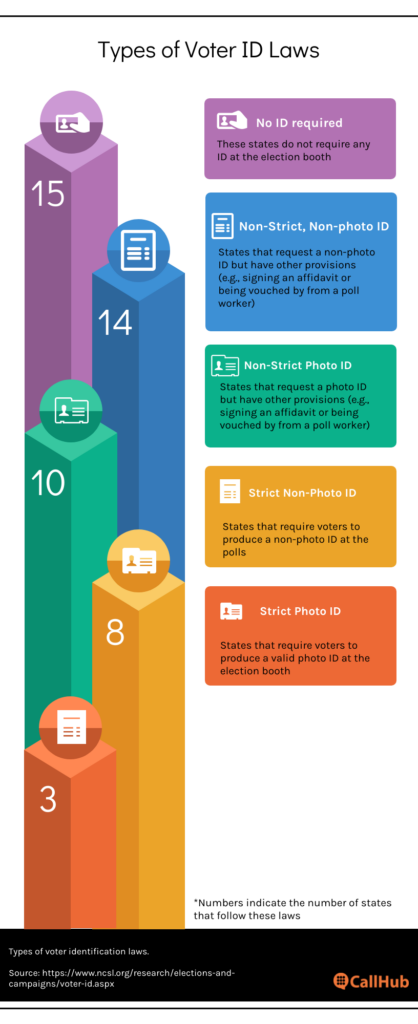
- 18 states require/request a photo ID
- 17 require/request a non-photo ID
- 11 states have strict voter identification laws
- 24 states have non-strict voter identification laws
- 15 states do not require or request an ID at the election booth.
| Photo ID | Non-photo ID | |
| Strict | Georgia Indiana Kansas Mississippi North Carolina Tennessee Virginia Wisconsin | Arizona North Dakota Ohio |
| Alabama Arkansas Florida Hawaii Idaho Louisiana Michigan Rhode Island South Dakota Texas | Alaska Colorado Connecticut Delaware Iowa Kentucky Missouri Montana New Hampshire Oklahoma South Carolina Utah Washington West Virginia |
| No ID required | California Illinois Maine Maryland Massachusetts Minnesota Nebraska Nevada New Jersey New Mexico New York Oregon Pennsylvania Vermont Wyoming |
| Pro tip: “State voter ID laws change frequently; always confirm with your state election office, NCSL, or USAGov before you vote.” |
Exceptions to the voter ID law
States with strict voter identification laws (photo or non-photo) also sometimes make exceptions to accommodate beliefs or circumstances. Currently, 7 states make such exceptions. Let’s look at them in this table.
| State | Existing voter ID law | Exceptions |
| Indiana | Strict photo ID law | ◉ Religious objections to getting photographed ◉ Are needy/poor |
| Kansas | Strict photo ID law | ◉ Religious objections to getting photographed |
| Mississippi | Strict photo ID law | ◉ Religious objections to getting photographed |
| South Carolina | Non-strict non-photo ID law | ◉Religious objections to getting photographed ◉ Voter has a “reasonable” impediment to getting a voter ID. |
| Tennessee | Strict photo ID law | ◉ Religious objections to getting photographed ◉ Are needy/poor |
| Texas | Non-strict photo ID | ◉ Religious objections to getting photographed ◉ Voter does not possess a voter ID as a result of a natural disaster |
| Wisconsin | Strict photo ID law | ◉ Religious objections to getting photographed ◉ Victims of domestic abuse, sexual abuse, or stalking who have a “confidential listing.” |
How CallHub helps you prepare voters
Campaigns and organizations can use outreach tools to ensure voter identification laws do not become a barrier to turnout.
- Use phone banking campaigns to explain local voter ID laws by state, walk supporters through accepted IDs, and answer questions ahead of Election Day.
- Run targeted SMS campaigns that link to official resources where voters can check whether their driver’s license, Real ID, or other documents will work.
- Combine calling and texting data to track who still needs information about identification and follow up before the election.
The way forward
Strict voter ID laws have faced criticism for disproportionately affecting minority communities and people with disabilities. States have also faced scrutiny for issuing vague laws or confusing rules around acceptable identification.
To reduce last-minute confusion, campaigns can use CallHub to proactively remind voters through calls and texts what identification is accepted in their state, helping ensure voters arrive prepared on Election Day. Try CallHub today and get started!
FAQs about voter identification laws
Do all states require a voter ID to vote in person?
No. Many states require or request ID, but some do not require ID at the polls for most voters, though separate rules may apply to first-time voters.
What forms of ID are usually accepted?
Commonly accepted ID includes driver’s licenses, state IDs, US passports, some student or tribal IDs, and in non-photo ID states, documents like utility bills or bank statements.
What if I show up on Election Day without ID?
In strict states, you may be given a provisional ballot that is accepted and cast only if you return with ID or provide extra information after Election Day; in non-strict states, you might sign an affidavit instead.
Are voter ID laws connected to Social Security numbers?
Some registration and first-time voter rules use the last four digits of a Social Security number for verification, but most in-person ID requirements focus on physical documents.
How many states have voter ID to vote rules?
The exact number changes as legislatures update laws and courts rule on challenges, so the safest approach is to check your state’s latest requirements or official federal resources.